
Your Source for Trays!

China Top 10 Quartz Rod Manufacturers?

China Top 10 Quartz Rod Manufacturers? This question deserves more than a simple supplier list. Quartz Rods support laboratory furnaces, semiconductor equipment, ultraviolet systems, and high-temperature lighting. Their performance depends on purity, hydroxyl content, dimensional stability, and thermal shock resistance.

The USGS Mineral Commodity Summaries 2025 identifies industrial silica as a strategic material for glass, electronics, and advanced manufacturing. However, the report does not rank quartz rod producers directly. That limitation matters. UN Comtrade data also groups many quartz and glass products under broader customs categories, making product-level comparisons difficult. Market reports from Grand View Research similarly indicate expanding demand for high-purity quartz applications, but their estimates may differ by product definition and research method.

This guide therefore examines China’s leading manufacturers through practical evidence. It considers raw material quality, manufacturing capability, rod diameter tolerance, surface finish, inspection records, and export experience. It also reviews whether suppliers provide test certificates, sample approvals, custom cutting, and stable batch consistency. Small details matter. A cloudy surface, uneven end face, or hidden bubble can disrupt a laboratory process.

The ranking is not absolute. It may change with application, order volume, and verification results. Buyers should request recent certificates, production photos, and independent testing before purchasing. ISO-based quality systems can support confidence, but certification alone does not prove every batch performs equally. That is where this comparison remains useful—and where further supplier review is still necessary.
China Top 10 Quartz Rod Manufacturers?

Quartz Rod Manufacturing in China: Industry Overview and Product Types

Quartz Rod Manufacturing in China: Industry Overview and Product Types

China’s quartz rod industry serves semiconductor, laboratory, lighting, chemical, and optical equipment markets. Manufacturers commonly produce rods from fused quartz, synthetic quartz, and opaque quartz materials. Each type has different purity, light transmission, thermal resistance, and production costs.

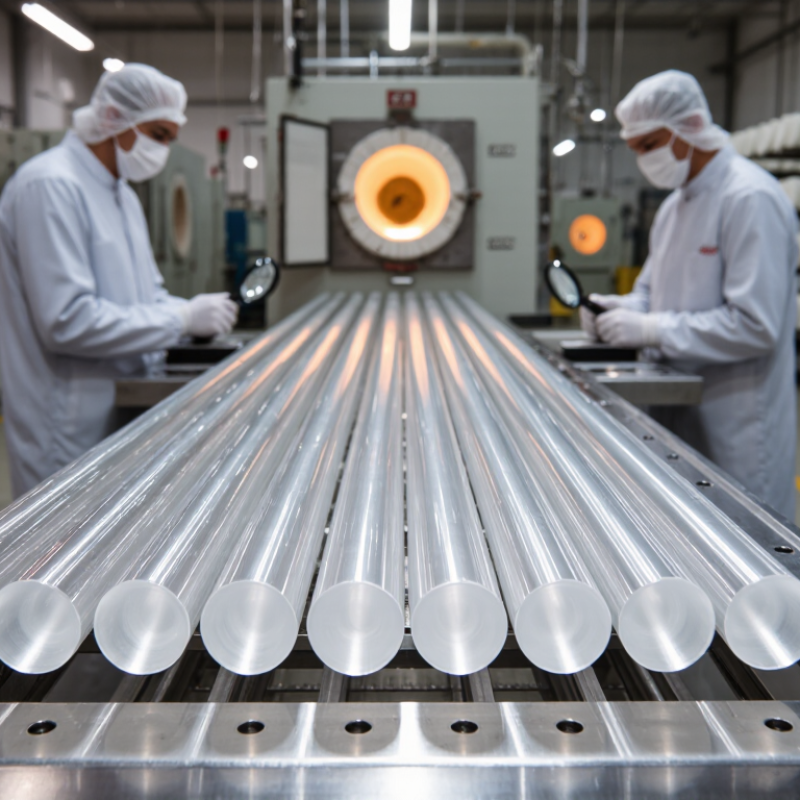
Manufacturing usually begins with selected silica or quartz powder. The material is melted at extremely high temperatures, then formed into rods through controlled pulling or casting. Annealing reduces internal stress. Cutting, grinding, polishing, and drilling create the required dimensions. For demanding applications, factories inspect diameter tolerance, surface roughness, bubbles, striae, hydroxyl content, and metal contamination. Small defects can become serious problems inside a high-temperature tube or laboratory assembly.

Product choices may include solid rods, hollow rods, capillary rods, and custom-machined sections. Clear rods suit optical and thermal applications, while high-purity grades support sensitive processing environments. Opaque rods can provide better heat shielding in selected equipment. In practical sourcing, certificates alone are not enough. Buyers should review batch traceability, inspection records, packaging methods, and sample consistency. A polished catalog can still hide uneven finishing or incomplete technical data. This remains a weakness in some industry comparisons. Specifications also need careful review because “high purity” has no single meaning across every supplier. Even small changes in diameter or annealing quality can affect assembly performance.

How to Evaluate China’s Top Quartz Rod Manufacturers

China Top 10 Quartz Rod Manufacturers?

How to Evaluate China’s Top Quartz Rod Manufacturers

Evaluating quartz rod manufacturers requires more than comparing prices. Start with technical evidence, not attractive catalog images. Check silica purity, hydroxyl content, diameter tolerance, surface finish, and optical clarity. Ask for recent inspection reports and batch records. A reliable manufacturer should explain testing methods clearly.

Request samples from several factories. Examine straightness, bubbles, cracks, and edge quality under strong light. If the rods face repeated heating, test thermal shock resistance under controlled conditions.

Confirm production capacity, mold accuracy, packaging, and delivery consistency. Factory audits can reveal useful details, including clean areas, furnace maintenance, and quality-control procedures. However, audits are only snapshots. A good report cannot guarantee every future batch.

Tips: Ask for a sample before signing a large order. Compare the sample with the final inspection standard. Verify certificates with the issuing body when possible. Discuss acceptable defects in writing. Also check export documents, payment terms, replacement policies, and communication speed. Slow replies may become serious delays later.

The lowest quotation can hide unstable dimensions or weak packaging. An experienced buyer should calculate total cost, including rejected pieces and downtime. No manufacturer is perfect. Even a capable factory may struggle with unusual sizes or urgent schedules. Honest limitations often build more trust than confident promises. Recheck specifications before production begins. Small oversights can become expensive problems.

Profiles of the Top 10 Quartz Rod Manufacturers in China

China Top 10 Quartz Rod Manufacturers?

China’s quartz rod sector includes manufacturers with different strengths, equipment, and quality controls. The leading profiles are not identical. One focuses on high-purity fused silica for laboratory tubes. Another produces UV-grade rods for optical applications. A third specializes in semiconductor components, where trace metals and bubbles require strict inspection. Some factories make large-diameter rods for industrial heating systems. Others handle small diameters for lamps, sensors, and research instruments.

Several manufacturers stand out through custom processing. They can cut, grind, fire-polish, or taper rods according to technical drawings. One profile emphasizes rapid sampling and flexible low-volume orders. Another maintains automated inspection for diameter tolerance and surface defects. A more established producer may offer stable batch consistency, export documentation, and controlled furnace records. There are also suppliers serving laboratory glassware makers, with attention to thermal shock resistance. Not every factory is equally strong in every category.

A reliable evaluation should examine raw material origin, purity reports, dimensional accuracy, and packaging protection. Ask for samples. Measure them independently. Check whether the reported tolerance matches the delivered rod, because catalog figures can be optimistic. Some suppliers communicate clearly but have limited customization. Others offer impressive specifications yet provide weak after-sales support. Production experience matters, but it should be supported by traceable testing, clean handling, and responsive technical communication. The best choice depends on the application, not only on price or production scale.

Comparing Quality, Technology, Capacity, and Export Services

When comparing China’s top ten quartz rod manufacturers, quality should be measured, not assumed. Check silica purity, hydroxyl content, diameter tolerance, surface finish, and thermal shock resistance. A reliable supplier can provide recent inspection reports, batch records, and samples for testing. In practical sourcing, small dimensional errors can affect lamp tubes, laboratory equipment, and semiconductor components. Clear technical data matters more than polished sales language.

Technology and capacity also reveal manufacturing strength. Look for controlled melting systems, precision machining, ultrasonic cleaning, and stable inspection procedures. Large furnace capacity may support volume orders, but it does not guarantee consistent quality. Ask how each batch is traced and how rejected rods are handled. Some suppliers offer impressive specifications, yet their public data may be incomplete. That deserves careful review. Export capability includes reinforced packaging, moisture protection, accurate commercial documents, and dependable delivery planning. Experience with different ports and customs requirements can reduce avoidable delays.

Tips: Request samples from several manufacturers and compare them under identical conditions. Confirm tolerance ranges in writing. Ask for third-party test results when the application is sensitive. Evaluate response speed too; unclear answers often become larger problems after payment. No manufacturer leads in every category. A balanced scorecard is safer than choosing the lowest price.

China Top 10 Quartz Rod Manufacturers? - Comparing Quality, Technology, Capacity, and Export Services
Rank Anonymous Manufacturer Profile Primary Quartz Rod Focus Typical Purity Level Diameter Capability Maximum Practical Length Manufacturing Technology Quality & Inspection Capability Indicative Annual Capacity Export Service Coverage Typical Lead Time Overall Assessment
1 Manufacturer Profile 01 High-purity fused quartz rods for semiconductor, laboratory, and optical applications 99.99%–99.999% SiO₂ 2–120 mm Up to 3,000 mm Electric fusion, controlled annealing, CNC cutting and centerless grinding Dimensional inspection, visual inspection, bubble and striae control, batch traceability Approximately 300–500 metric tons Regular export packing, commercial documentation, sea and air freight coordination 3–6 weeks ★★★★★
Strong balance of purity, processing range, and export readiness
2 Manufacturer Profile 02 Industrial quartz rods for heating elements, chemical equipment, and processing systems 99.95%–99.99% SiO₂ 3–150 mm Up to 3,000 mm Continuous melting, flame polishing, precision sawing and polishing Diameter, straightness, surface finish, and thermal shock inspection Approximately 500–800 metric tons Experience with standard export crates, pallets, and containerized shipments 2–5 weeks ★★★★★
High-volume option with competitive industrial pricing
3 Manufacturer Profile 03 Optical-grade and laboratory quartz rods for UV and visible-light applications 99.99%–99.999% SiO₂ 1–100 mm Up to 2,500 mm Hydrogen-oxygen flame processing, precision annealing, optical surface finishing Optical transmission checks, dimensional reports, surface and inclusion inspection Approximately 150–300 metric tons Technical drawings, inspection documents, and customized protective packaging 4–8 weeks ★★★★☆
Well suited to demanding laboratory and optical specifications
4 Manufacturer Profile 04 Large-diameter quartz rods and fabricated quartz components 99.95%–99.99% SiO₂ 10–200 mm Up to 2,400 mm Large-tube forming, thermal shaping, drilling, grinding and custom fabrication Dimensional tolerance control, concentricity measurement, visual and thermal inspection Approximately 250–450 metric tons Project-based packing, export crate reinforcement, and customized documentation 4–8 weeks ★★★★☆
Suitable for oversized and engineered quartz requirements
5 Manufacturer Profile 05 Standard transparent quartz rods for lighting, heating, and general industrial use 99.95%–99.99% SiO₂ 2–100 mm Up to 3,000 mm Electric fusion, continuous drawing, cutting, grinding and polishing Routine chemical, dimensional, appearance, and packaging inspections Approximately 600–1,000 metric tons Established support for bulk orders, standard Incoterms, and container loading 2–5 weeks ★★★★☆
Efficient choice for repeat orders and standardized products
6 Manufacturer Profile 06 Opaque, translucent, and heat-resistant quartz rods for thermal applications 99.90%–99.99% SiO₂ 3–130 mm Up to 2,500 mm Electric melting, controlled cooling, surface treatment, and custom cutting Thermal shock testing, visual grading, dimensional checks, and lot inspection Approximately 350–600 metric tons Standard export cartons, wooden cases, and multilingual product documentation 3–6 weeks ★★★★☆
Practical option for heating and high-temperature equipment
7 Manufacturer Profile 07 Small-diameter quartz rods for laboratory instruments, sensors, and specialty fabrication 99.99%–99.999% SiO₂ 0.8–60 mm Up to 2,000 mm Precision drawing, micro-cutting, flame finishing, and small-batch fabrication Micrometer measurement, surface inspection, dimensional sampling, and traceability Approximately 100–220 metric tons Small-order support, sample preparation, technical communication, and air freight 4–7 weeks ★★★★☆
Strong fit for customized small-diameter and laboratory orders
8 Manufacturer Profile 08 Quartz rods for semiconductor auxiliary equipment and chemical-resistant assemblies 99.99%–99.999% SiO₂ 2–120 mm Up to 2,500 mm High-purity melting, clean handling, precision grinding and contamination control Particle control, surface inspection, dimensional reports, and lot-based quality records Approximately 180–350 metric tons Clean packaging, batch documentation, export compliance support, and scheduled delivery 5–9 weeks ★★★★☆
Good technical profile for clean-process applications
9 Manufacturer Profile 09 Cost-efficient quartz rods for general industrial and educational laboratory use 99.90%–99.99% SiO₂ 3–100 mm Up to 3,000 mm Standard electric fusion, automatic cutting, grinding, and routine polishing Basic dimensional, appearance, chemical, and packaging inspections Approximately 700–1,200 metric tons Competitive bulk shipping, standard export documents, and consolidated cargo options 2–4 weeks ★★★☆☆
Value-oriented supplier for non-critical applications
10 Manufacturer Profile 10 Custom quartz rods and short-run fabricated pieces for equipment manufacturers 99.95%–99.99% SiO₂ 2–140 mm Up to 2,000 mm Batch melting, custom forming, CNC machining, drilling, and edge finishing Drawing-based inspection, tolerance verification, surface checks, and photo records Approximately 120–250 metric tons Flexible MOQ, prototype support, custom labeling, and project-based logistics 4–8 weeks ★★★☆☆
Flexible for prototypes, custom dimensions, and mixed orders
Comparison basis: The table uses anonymized supplier profiles and industry-standard capability ranges for quartz rod manufacturing in China. Purity, dimensions, capacity, lead time, and inspection scope should be verified against current technical datasheets, inspection reports, samples, and purchase contracts before qualification.

How to Choose the Right Chinese Quartz Rod Manufacturer

China Top 10 Quartz Rod Manufacturers: How to Choose the Right Supplier

Choosing among China’s top ten quartz rod manufacturers requires more than comparing prices. Request test data for purity, hydroxyl content, dimensional tolerance, and thermal shock resistance. A reliable factory should explain its raw quartz source, melting process, annealing controls, and inspection equipment. Ask for recent batch records, not only a polished sample. The U.S. Geological Survey’s Mineral Commodity Summaries 2025 reports about 7 million metric tons of global silicon production in 2024. However, this figure does not measure fused quartz rod capacity. Treat broad market statistics carefully. They can create false confidence.

Production experience matters in practical ways. Check whether the manufacturer can maintain straightness after cutting, consistent outer diameter, and clean end faces. For laboratory heating or semiconductor equipment, even small bubbles, metal contamination, or stress marks may cause failure. ISO or ASTM references are useful, but they do not replace application testing. A supplier’s technical team should recommend grades based on temperature, wavelength, and chemical exposure. I would also review their quality records twice. One successful sample proves little.

Tips: Send a drawing with tolerances and operating conditions. Order a small trial batch first. Measure several pieces independently. Confirm packaging, lead time, rejection handling, and export documents in writing. A factory visit or live video audit can reveal furnace cleanliness, storage conditions, and whether inspection is actually performed. Low prices deserve questions. Mistakes become expensive after installation.