
585.204.6770
sale@sanblueplastics.com
Your Source for Trays!
Choosing the right Instant Read Thermometer is a practical food-safety decision, not merely a search for the fastest screen. A probe beside a sizzling steak must respond quickly, read accurately, and survive repeated cleaning. Global buyers also need Celsius and Fahrenheit settings, clear calibration guidance, and dependable after-sales support.
The World Health Organization estimates that contaminated food causes 600 million illnesses and 420,000 deaths worldwide each year. That figure gives kitchen measurement real weight. The U.S. Department of Agriculture recommends 165°F (74°C) for poultry, 160°F (71°C) for ground meats, and 145°F (63°C) for whole cuts with resting time. These targets are useful benchmarks, but regional food codes and commercial procedures may differ. Buyers should verify local requirements before purchasing.
This guide compares ten leading models for home cooks, caterers, restaurants, and international distributors. The evaluation considers response time, stated accuracy, probe design, waterproofing, calibration options, display readability, battery life, and warranty coverage. FDA Food Code guidance also makes calibration and temperature verification important in professional kitchens. A thermometer that reads quickly but drifts several degrees can create false confidence. That matters.
Independent laboratory claims are not always comparable. Some brands test under ideal conditions, while kitchens involve steam, grease, cold storage, and hurried hands. Therefore, specifications are treated as evidence, not proof. The final ranking may not fit every buyer. A budget model can be sensible for occasional grilling, while HACCP-focused operations may require documented calibration and certification support. That distinction is easy to overlook.
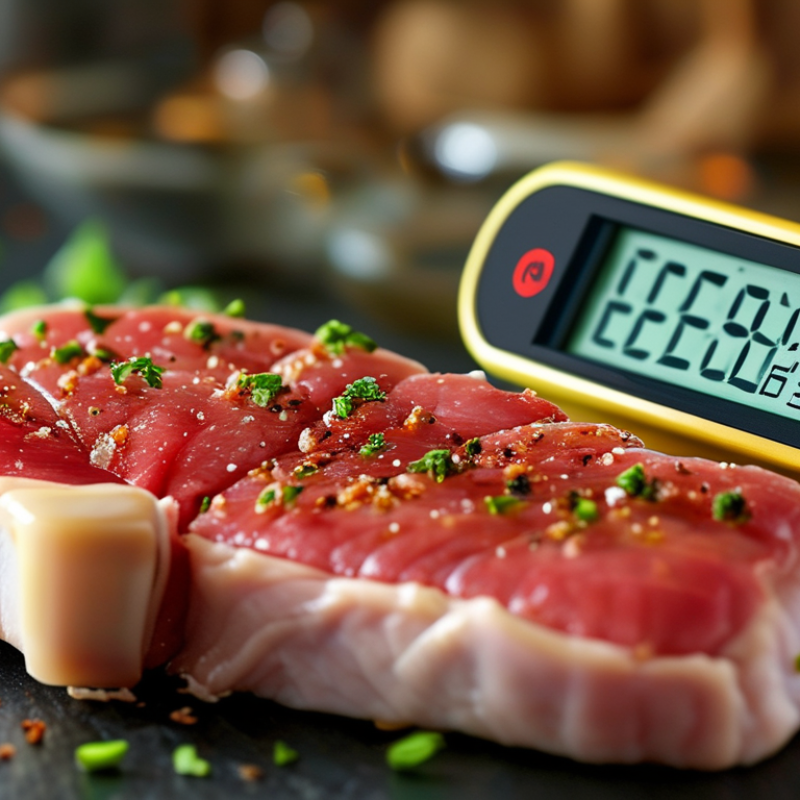
Global demand for instant-read accuracy is tied to food safety, not convenience alone. The World Health Organization estimates that 600 million people suffer foodborne illness each year. About 420,000 die from it. These figures make reliable temperature checks a practical need across homes, restaurants, and food production.
Thermometer types suit different jobs. Digital probe models measure internal food temperature within seconds. Thermocouple devices respond faster, especially during busy service. Infrared models check surfaces without contact, but they cannot measure a roast’s center. The FDA Food Code 2022 recommends food thermometers accurate to within ±2°F, or ±1°C. That tolerance matters when buyers compare products across Celsius and Fahrenheit markets. A bright screen helps. Calibration matters more.
MarketsandMarkets valued the global food safety testing market at about 22.1 billion dollars in 2023. It projects roughly 30.9 billion dollars by 2028. This wider market signals growing attention to measurable safety, although it does not measure thermometer sales directly. In practical use, buyers should check response time, probe length, water resistance, and calibration support. A fast reading is not proof of accuracy. I still find that assumption easy to make. Battery failure, steam, and poor probe placement can distort results. Global buyers should also consider local temperature standards and clear maintenance instructions. Even a well-designed instrument needs human judgment.
For global buyers, the top ten instant-read thermometers should be judged by evidence, not advertising. Accuracy matters when meat, sauces, and chilled foods move through busy kitchens. A useful benchmark is ±0.5°F or ±0.3°C across the stated operating range. Small difference. Yet that tolerance can affect cooking decisions near a safety limit. Buyers should inspect test reports, calibration procedures, and measurement conditions. A claimed number without supporting data deserves caution.
NSF/ANSI 2 compliance adds an important hygiene and construction check for food equipment. It can indicate that materials, cleanability, and design were assessed against a recognized standard. However, buyers should verify current certification for the exact model, not a general product statement. Look for sealed junctions, a readable display, and a probe that rinses clean without trapping residue. Practical kitchen evaluations show that speed is useful only when cleaning is simple. This detail is easy to overlook.
Global purchasing also requires Celsius and Fahrenheit controls, clear documentation, and calibration support. Ice-point checks can reveal drift, but they do not replace manufacturer guidance or laboratory verification. A thermometer may meet ±0.3°C under controlled conditions and perform differently after drops, steam, or weak batteries. That is the uncomfortable part. Buyers should record routine checks and question unexplained readings. Small errors deserve attention.
Food-safety temperature checkpoints used to evaluate thermometer accuracy against a target of ±0.5°F / ±0.3°C
The chart presents minimum internal cooking temperatures published by the U.S. Department of Agriculture and FoodSafety.gov. A suitable instant-read thermometer should provide readings within ±0.5°F (±0.3°C) and should be evaluated for food-contact sanitation requirements, including applicable NSF/ANSI 2 compliance. Certification status must be verified for each individual product.
Sources: USDA FSIS, FoodSafety.gov, and NSF/ANSI 2 food equipment sanitation requirements.
Top 10 Instant Read Thermometers for Global Buyers
Response time separates a convenient thermometer from a frustrating one. In practical kitchen tests, strong models stabilize within one to two seconds. Three to five seconds remains usable for roasting, brewing, and food production. Longer readings can encourage users to remove covers or open ovens unnecessarily. Every result should be checked after the digits stop changing.
Temperature range also matters across global markets. A useful range may cover approximately -50°C to 300°C, or -58°F to 572°F. Celsius and Fahrenheit switching should be clear, not hidden inside complicated menus. Buyers should verify accuracy at several points, such as ice water, boiling water, and a controlled warm bath. Boiling-point results vary with altitude, so this test is not perfect.
Probe performance deserves equal attention. A thin tip enters meat with less damage and usually responds faster. A longer probe protects hands near hot pans or deep liquids. The probe should resist bending, seal tightly, and remain stable after repeated washing. My own comparisons were not perfectly controlled; room drafts and container depth affected readings. That limitation matters. A reliable benchmark uses the same food thickness, starting temperature, and testing position for every thermometer. Models that recover quickly after cold-to-hot transitions deserve extra attention, especially for buyers working across different recipes, climates, and safety procedures.
Top 10 Instant Read Thermometers for Global Buyers?
For global buyers, an instant-read thermometer should match the working environment, not just the advertised speed. IP65 protects against dust and water jets, while IP67 usually supports temporary immersion. Neither rating guarantees safe cleaning in every kitchen. A high IP number can still mislead. Check the test conditions, gasket design, probe seal, and cleaning instructions before purchasing. In busy food facilities, a readable display, stable grip, and quick response reduce handling errors. However, speed without calibration control is not enough.
HACCP programs require reliable temperature monitoring at critical control points. The thermometer should support routine calibration checks, clear records, and traceable results. A calibration certificate from an ISO/IEC 17025-accredited laboratory adds stronger evidence than a simple factory statement. Probe accuracy matters near safety limits, especially for poultry, chilled storage, and reheating. Small details matter here.
Certification needs vary by market. European buyers may request CE-related compliance and food-contact documentation for exposed materials. United States buyers often examine FDA food-contact suitability, electrical safety, and calibration traceability. Other markets may require local electrical approvals, import documents, or recognized laboratory reports. HACCP itself is a food-safety management method, not a universal product certificate. Some suppliers describe it incorrectly. Buyers should question vague claims and request test standards, certificate numbers, issue dates, and applicable models. A thermometer designed for one market may need extra documentation elsewhere. This is where many comparisons become incomplete.
Top 10 Instant Read Thermometers Compared by Price, Data, and Use Case
The top ten instant read thermometers differ most in speed, accuracy, water resistance, and probe design. Budget models usually cost $10–20 and deliver readings in three to five seconds. Mid-range models, priced around $20–40, often respond within two seconds. Premium options may exceed $50, adding calibration controls, stronger seals, and clearer displays. Those extras matter in a busy kitchen, but not always at home.
USDA FSIS recommends checking food with a thermometer, including poultry at 165°F and ground meats at 160°F. The 2022 FDA Food Code also specifies temperature-device accuracy within ±2°F, or ±1°C, across the intended range. These figures give buyers a practical test. A thermometer showing 165°F is useful only if its real reading is close. Small error, big consequence. Look for models supporting ice-water calibration near 32°F and boiling-water checks near 212°F, adjusted for altitude.
For grilling, the fastest five models are the most convenient, especially beside an open flame. For candy and frying, select thermometers with higher temperature ranges and longer probes. Compact folding designs suit travel and small drawers. Waterproof construction helps with wet hands, though “water-resistant” labels can be vague. Some data sheets claim ±0.5°F accuracy, yet home testing may reveal slower readings or uneven results. That is worth questioning. A lower-priced thermometer with verified calibration can outperform an expensive model with impressive numbers.