
585.204.6770
sale@sanblueplastics.com
Your Source for Trays!
What Are Bellows Valves and How Do They Work?
Bellows Valves are engineered for applications where ordinary stem seals may allow leakage, contamination, or maintenance problems. Their defining feature is a flexible metal bellows welded between the valve body and stem. As the stem moves, the bellows compresses or extends while keeping the process fluid isolated from the stem mechanism. This design creates a sealed pressure boundary around the moving stem.
The operating principle is practical. Turning the handwheel moves the stem and valve disc toward or away from the seat. The bellows follows that movement without exposing the process medium to packing materials. In laboratories, semiconductor systems, vacuum lines, and chemical plants, this separation can help protect product purity and reduce fugitive emissions. It is not magic. Bellows Valves still depend on correct material selection, welding quality, seat design, and installation.
Experienced engineers examine pressure, temperature, fluid compatibility, and expected cycling before choosing a valve. A stainless-steel bellows may suit one service, while Hastelloy or another alloy may be necessary elsewhere. The valve must also be tested for seat leakage and bellows integrity. Small installation errors can create large consequences.
Bellows fatigue deserves attention. Repeated flexing can eventually weaken the metal, especially when pressure, heat, or vibration exceeds the design range. No valve is universally ideal. Understanding how the bellows moves, seals, and ages helps users select reliable equipment rather than trusting appearance alone.
Bellows Valves: Definition, Purpose, and Core Components
What Are Bellows Valves and How Do They Work?
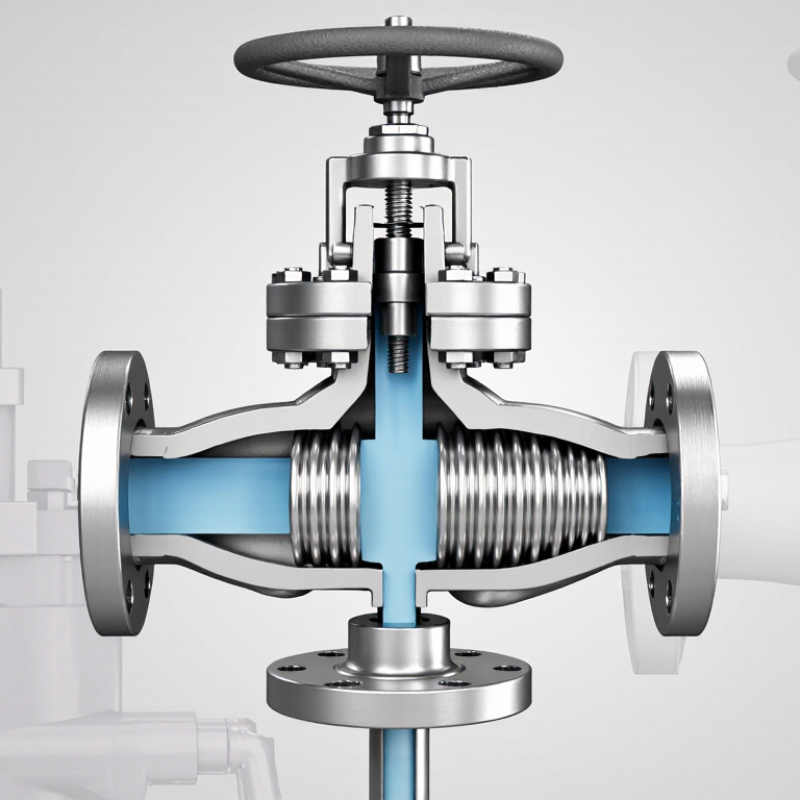
Bellows valves are isolation valves designed to prevent process fluid from escaping around the stem. A flexible metal bellows forms a sealed barrier between the fluid and the atmosphere. This design is valuable when handling toxic, corrosive, radioactive, vacuum, or high-purity media. The bellows is central. It expands and contracts without rotating as the stem moves. That movement opens or closes the valve seat. The main components include the valve body, bonnet, stem, metal bellows, seat, plug, handwheel, and actuator. Many designs also include secondary packing or a monitoring port for added protection.
During operation, turning the handwheel moves the stem vertically. The stem carries the plug away from, or toward, the seat. Meanwhile, the bellows flexes axially and maintains the pressure boundary. Its welded joints and layered metal structure require careful engineering. Material selection depends on temperature, pressure, corrosion, and cycle frequency. A common mistake is assuming every bellows valve suits every service. It does not. Repeated thermal cycling can cause fatigue, even when external leakage remains absent. In field inspections, technicians should check stroke smoothness, seat shutoff, bonnet condition, and any monitoring connection. Leak testing may reveal problems before visible damage appears. No valve is maintenance-free. The bellows reduces one major leak path, but correct sizing, installation, and periodic testing still determine reliability.
| Data Dimension | Key Information | Definition, Purpose, or Operating Detail |
|---|---|---|
| Definition | Bellows valve | A valve that uses a flexible, corrugated metal bellows as a sealed barrier around the valve stem. The bellows isolates the process fluid from the external environment and helps prevent stem leakage. |
| Primary purpose | External leakage control | The bellows forms a hermetic or highly leak-resistant seal around the moving stem, reducing fugitive emissions and protecting the surrounding area from hazardous, toxic, radioactive, corrosive, or high-purity media. |
| Typical valve designs | Globe, gate, and control valves | Bellows sealing technology is commonly integrated into globe and gate valves and may also be used in specialized control or isolation valves where stem-emission control is important. |
| Main operating principle | Axial expansion and contraction | When the valve stem moves, the corrugated bellows compresses or extends axially. It follows the stem movement while maintaining a sealed separation between the process fluid and the valve bonnet area. |
| Flow-control element | Disc, plug, or wedge | The internal closure element moves toward or away from the valve seat to stop, start, or regulate flow. The bellows does not normally control flow directly; it seals the stem movement path. |
| Primary sealing surface | Valve seat and closure element | The seat and closure element provide the internal shutoff. Their design determines the valve's flow direction, pressure-drop characteristics, and shutoff performance. |
| Secondary sealing system | Gasket and packing arrangement | A bonnet gasket seals the pressure boundary between body sections. Some designs also include packing as a backup seal, although the bellows is the principal dynamic stem-sealing barrier. |
| Core component | Metal bellows | A thin-walled, convoluted metallic element designed to flex repeatedly within a specified stroke and pressure range. Its material, wall thickness, number of convolutions, and weld quality affect service life. |
| Core component | Valve body | The pressure-retaining housing that contains the flow passage, seat, closure element, and process connections. Body geometry influences pressure loss and maintenance access. |
| Core component | Bonnet | The upper housing attached to the valve body. It supports the stem and actuator interface and encloses the bellows assembly while maintaining the pressure boundary. |
| Core component | Valve stem | The mechanical member that transfers motion from a handwheel or actuator to the closure element. In a bellows valve, the stem is connected to the bellows so that movement does not create an open leakage path. |
| Core component | Actuator or handwheel | The operating mechanism that moves the stem. Manual handwheels are common for isolation service, while pneumatic, electric, or hydraulic actuators may be used for automated operation. |
| Common bellows materials | Austenitic stainless steels and nickel-based alloys | Material selection depends on temperature, pressure, corrosion resistance, fatigue requirements, and process compatibility. Stainless steel is widely used, while nickel-based alloys may be selected for more demanding chemical or thermal conditions. |
| Pressure boundary | Body, bonnet, bellows, and joints | All pressure-retaining parts must be designed for the intended pressure and temperature range. Welded bellows joints require careful manufacturing and inspection because defects can affect leakage performance and fatigue life. |
| Leakage behavior | Reduced stem fugitive emissions | Because the bellows separates the process fluid from the stem packing area, emissions through the stem interface are substantially reduced compared with conventional packed-stem arrangements when correctly designed and maintained. |
| Typical applications | Chemical processing, pharmaceuticals, vacuum systems, and power generation | These valves are used where preventing external leakage is important, including hazardous-fluid isolation, high-purity service, vacuum service, and systems handling hot or corrosive media. |
| Advantages | Leak prevention and contamination control | Key benefits include low external emissions, improved operator and environmental protection, reduced process contamination, and suitability for fluids that should not contact conventional stem packing. |
| Limitations | Fatigue, stroke, and cost considerations | The bellows has a finite flex life and must remain within its rated stroke, pressure, temperature, and cycle limits. Bellows valves can also be more expensive and may require more specialized inspection than conventional packed valves. |
| Failure modes | Fatigue cracking, corrosion, and mechanical damage | Repeated cycling, excessive pressure, thermal stress, vibration, corrosion, improper installation, or overstressing can damage the bellows and compromise its sealing function. |
| Inspection focus | Bellows integrity and valve-seat condition | Maintenance should consider operating cycles, signs of external leakage, stem movement, bonnet and flange joints, seat tightness, corrosion, and any pressure or leak testing required by the applicable procedure. |
| Selection criteria | Media, pressure, temperature, cycles, and connection type | A suitable valve is selected by matching the process fluid, pressure class, operating temperature, required flow capacity, shutoff needs, cycle frequency, materials, end connections, and actuator requirements. |